PoE · ETHERNET · EMBEDDED SYSTEM
PoE Relay / IO Card
Hardware, PCB, and embedded-software development was completed for a PoE-powered, Ethernet-connected four-relay IO card used in a turnstile application.
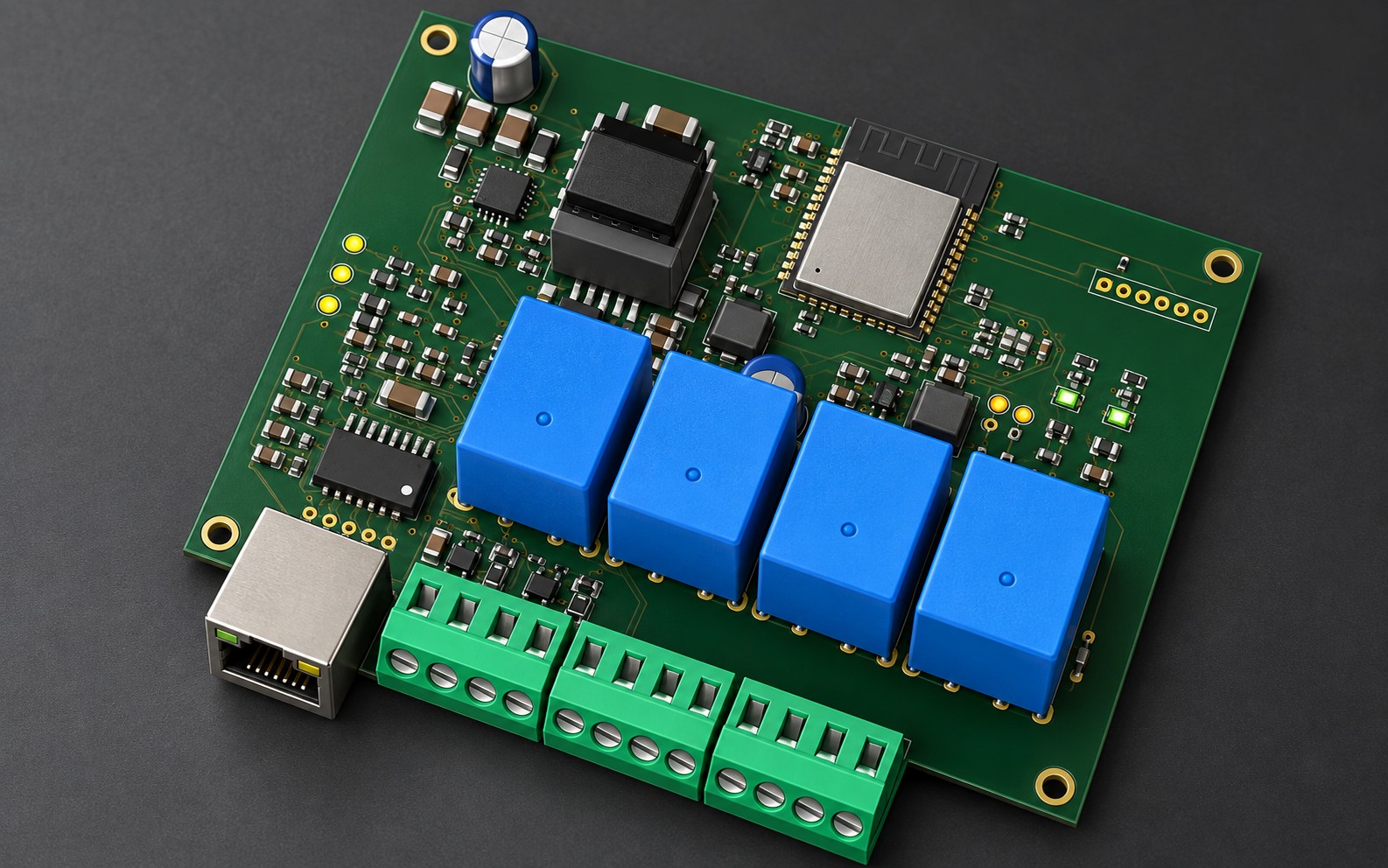
Turnstile control over one cable
The board was developed to reduce separate power and communication cabling in turnstile control. It is powered through an IEEE 802.3af PoE input, while Ethernet carries relay commands and input-state communication through the same device.
Hardware architecture
An ESP32-WROOM-32E-N4, LAN8720A 10/100 Ethernet PHY, PoE power stage, four dry-contact relay outputs, and two optically isolated digital inputs are integrated on one four-layer board. The RJ45, power conversion, and field terminals are arranged in distinct functional zones.
Relay behavior
In the turnstile profile, the first three relays are mutually exclusive and use a 10 ms break-before-make interval when direction changes; the fourth relay remains independent. In the alternative barrier profile, all four channels operate independently. Pulse duration is configurable from 100 to 5000 ms, and a common enable line supports fail-safe shutdown.
Local management and updates
The firmware includes local configuration, status monitoring, and watchdog tasks. The local-Ethernet OTA flow uses file-size and SHA-256 validation, with a rollback strategy for failed updates.
Design verification
At design lock, the four-layer KiCad 10 PCB completed ERC and DRC checks with zero errors and zero open connections. BOM and component-placement outputs were prepared for manufacturing, and the hardware and embedded software were completed together.